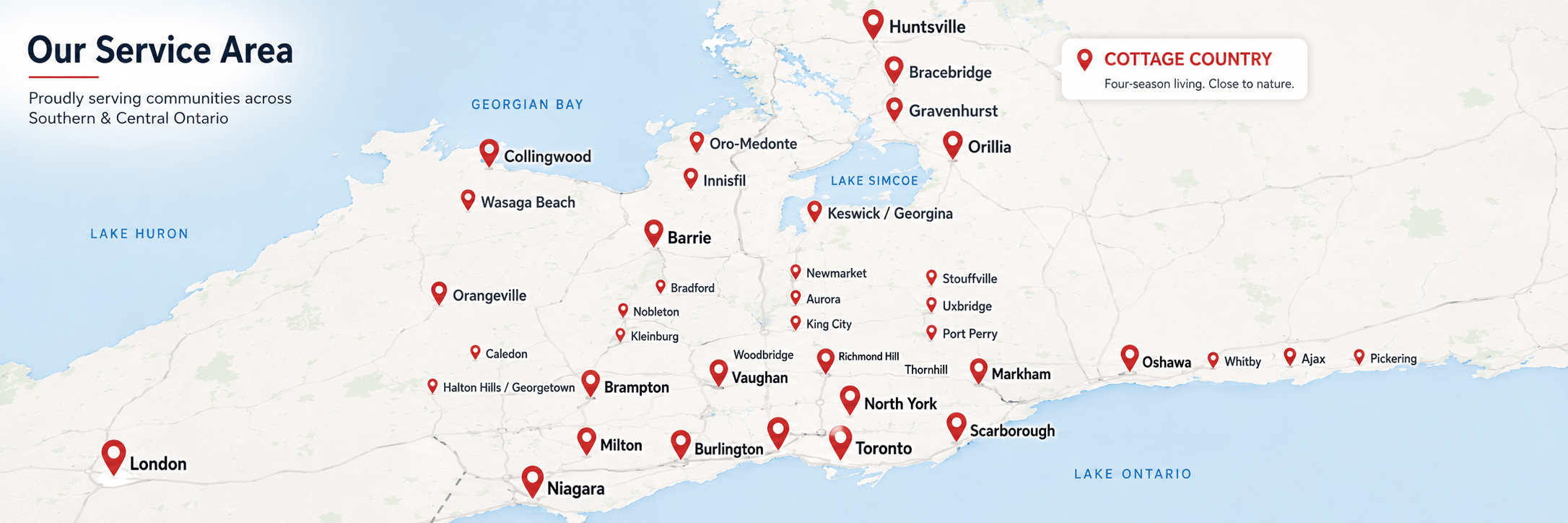
Where we work across Ontario
Our main service areas
Most of our work happens in four places: Bradford West Gwillimbury, where we are based; Barrie and Simcoe County; the Muskoka lakes; and Toronto and the GTA. These are the pages to start with.
How the regions differ
Bradford, Newmarket and the Holland Marsh
This is our home base. Bradford sits right next to the Holland Marsh, where deep organic muck soil sits over more stable mineral ground. Poured footings struggle in that kind of soil, so helical piles are the practical choice. We drive them down past the soft layer until the torque reading confirms solid load-bearing ground. Frost here runs to about four feet, and every pile anchors well below it. We install across Bradford, Newmarket, East Gwillimbury, Innisfil and Keswick for new homes, additions and decks. See our residential foundations and helical piles pages.
Toronto and the GTA
Across Toronto, Vaughan, Richmond Hill, Markham, Brampton and Mississauga, tight lots and existing structures make access the main challenge. Our low-clearance rigs fit where a full excavation crew cannot. Much of the GTA sits on clay left behind by glacial Lake Iroquois, which holds water and moves with the seasons. Helical piles skip that active layer and anchor in stable soil below. Most local work is additions, decks and commercial retrofits. See our commercial and industrial and deck foundation pages.
Barrie and Simcoe County
Simcoe County soils range from sandy loam to heavy clay, and the frost line sits deeper than it does in the city, often past four and a half feet. We install for custom homes, additions and outbuildings across Barrie, Innisfil, Oro-Medonte, Orillia, Wasaga Beach and Collingwood. Test piles help us read the soil before the main build on larger jobs. See our house and cottage foundations page.
Muskoka and cottage country
Muskoka, Gravenhurst, Bracebridge and Huntsville sit on the Canadian Shield, where a thin layer of soil covers granite bedrock. That defeats poured footings, but it suits helical piles well. We torque each pile down to refusal on the rock, which gives a solid anchor even on steep and waterfront lots. This is where we do a lot of cottage, deck and dock work. See our cottage foundations and nautical and marine pages.
Durham Region
Ajax, Pickering, Whitby, Oshawa, Port Perry and Uxbridge sit largely on clay till that heaves as it freezes and thaws. Helical piles reach stable ground below the frost line with no excavation and no cure time, which works for both home additions and commercial equipment pads. See our residential and commercial pages.
Every town we serve, by region
Each link opens that town’s own page. If your project sits outside these areas, call us and we will tell you honestly whether we can reach it.
Simcoe County and Georgian Bay
- Barrie: Kempenfelt Bay lots, heavy clay and a frost line that runs deeper than the GTA.
- Innisfil: Lake Simcoe shoreline properties and cottages being converted to year-round homes.
- Gilford: Lakeside village on Cook’s Bay, mostly decks, docks and cottage additions.
- Lefroy: Lake Simcoe shoreline south of Barrie, waterfront decks and boathouse foundations.
- Cookstown: Rural lots, shops and outbuildings around the Highway 89 and 27 crossroads.
- Thornton: Village lots and farm properties south of Barrie.
- Angus: Nottawasaga River valley lots next to CFB Borden.
- Midhurst: Large wooded estate lots north of Barrie, often sloped.
- Orillia: Lake Couchiching and Lake Simcoe waterfront, cottages and docks.
- Wasaga Beach: Sandy ground along Georgian Bay, decks and cottage foundations.
- Collingwood: Georgian Bay shoreline and Blue Mountain chalet country.
- Stayner: Homes and additions on the Stayner clay plain.
- Creemore: Rural village lots and older homes on uneven terrain.
- New Tecumseth: Alliston, Beeton and Tottenham together: town lots and surrounding farmland.
- Beeton: Village lots and rural properties in New Tecumseth.
- Tottenham: Growing subdivisions and rural lots in south New Tecumseth.
Bradford and York Region
- Bradford West Gwillimbury: Our home base, right beside the Holland Marsh and its deep organic soils.
- Bradford East Gwillimbury: The east side of the Holland River, with clay and sand lots side by side.
- Holland Landing: Holland River lots where sandy and clay ground change from one site to the next.
- East Gwillimbury: Growing subdivisions and spacious rural properties.
- Queensville: New subdivisions going up on former farmland.
- Mt Albert: Village lots and rural acreages east of Newmarket.
- Newmarket: Established neighbourhoods with tight access and mature landscaping.
- Aurora: Clay, sand and gravel that changes from lot to lot across town and rural properties.
- Richmond Hill: Clay till that heaves with the seasons, with the Oak Ridges Moraine to the north.
- Vaughan: Fast-growing subdivisions on fill and glacial till, piles driven to undisturbed ground.
- Woodbridge: Established homes and new builds along the Humber River valley.
- Maple: Developed neighbourhoods running up to the Oak Ridges Moraine.
- Concord: Commercial and industrial lots along Highways 7 and 400, equipment pads and additions.
- Kleinburg: Estate lots where site access decides the equipment.
- Thornhill: Mature lots with established landscaping worth protecting.
- Markham: Restricted access and finished landscaping on most residential jobs.
- Stouffville: New subdivisions and rural lots at the edge of the Moraine.
- Ballantrae: Estate and golf-community lots on the Oak Ridges Moraine.
- King City: Uneven terrain and large estate lots on the Moraine.
- Nobleton: Rural estate properties west of King City.
- Schomberg: Village lots and farm properties in northwest King.
- Georgina: Lake Simcoe waterfront, cottages and new residential construction.
- Keswick: Lake Simcoe shoreline and canal lots.
- Sutton: Jackson’s Point and the Lake Simcoe shoreline.
Toronto and the west GTA
- Toronto: Tight lots, laneway suites and Lake Iroquois clay that moves with the seasons.
- North York: Established residential areas where access and existing structures rule out excavation.
- Scarborough: Bluff-side and ravine lots on compact glacial till.
- Etobicoke: Older homes and tight lots near major roads and established landscaping.
- Mississauga: From narrow Port Credit lakefront lots to the Erin Mills subdivisions.
- Brampton: Clay, sand and wet soils that change from lot to lot.
- Bolton: Humber valley lots in the town of Caledon.
- Caledon: Rural properties and builds along the Niagara Escarpment.
- Orangeville: Dufferin County town lots and rural builds.
- Oakville: Lakefront and established neighbourhoods.
- Burlington: From the Escarpment slopes down to the lakeshore.
- Milton: Fast-growing subdivisions under the Escarpment.
- Halton Hills: Rural lots plus Acton and Georgetown builds.
- Georgetown: Established neighbourhoods and newer subdivisions in Halton Hills.
- Hamilton: Clay, sand, gravel and fill, on the Mountain and in the lower city.
Durham Region
- Ajax: Clay till and lakefront lots east of Pickering.
- Pickering: From the waterfront up to the new Seaton subdivisions.
- Whitby: Clay, sand and gravel across residential and larger properties.
- Oshawa: Freeze-thaw clay, older homes and new north-end builds.
- Uxbridge: Oak Ridges Moraine hills and rural lots.
- Port Perry: Lake Scugog waterfront and rural properties.
Muskoka
- Gravenhurst: Lake Muskoka cottages and docks on Canadian Shield rock.
- Bracebridge: Muskoka River lots and cottage foundations on shallow soil over rock.
- Huntsville: Rocky, sloped and wooded lots, plus Lake of Bays and Fairy Lake waterfront.