

Published July 20, 2026. Last updated .
In this article
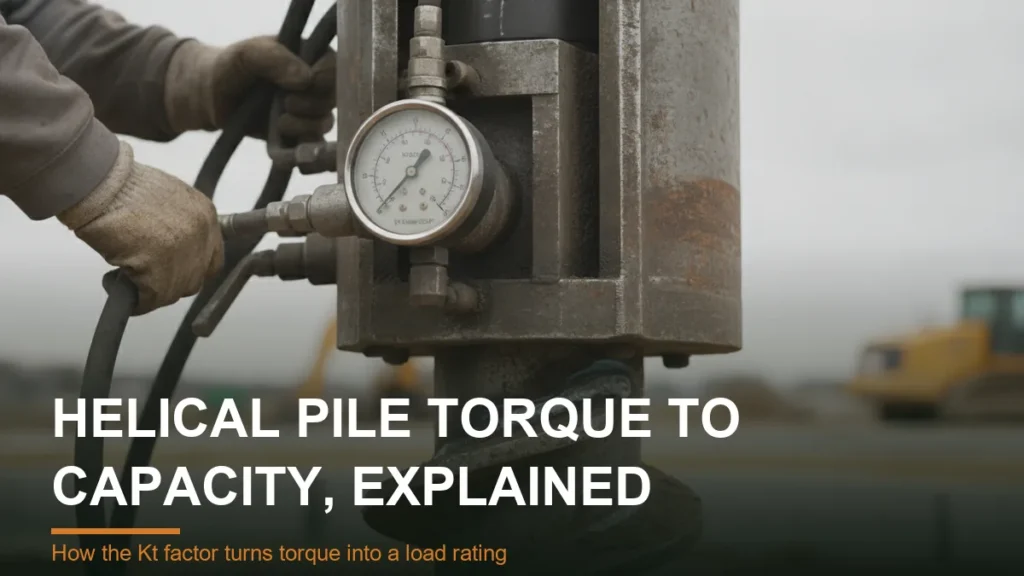
The gauge on the drive head reads 8,000 foot-pounds and stops climbing. To the crew that number is the finish line, because it means this helical pile can carry roughly 72,000 pounds. That conversion, from a torque reading to a load rating, is the single most important relationship in screw-pile engineering, and it runs on one short equation: ultimate capacity equals a factor called Kt multiplied by the final installation torque. Get the equation, and you understand how these foundations are proven.
This is not the same conversation as choosing a pile by its published load rating. That is a catalogue decision made before anyone breaks ground. The torque-to-capacity ratio is what happens during installation, when the ground itself tells you, in real time, whether the pile you picked actually reached the load you needed. This guide breaks the relationship down piece by piece, with a worked example and a sample chart, so the number on the gauge stops being a mystery.
The Whole Idea in One Equation
Strip away the jargon and the torque to capacity model is one line: ultimate capacity = Kt x torque. Torque is the twisting effort, in foot-pounds, that the hydraulic drive head applies to advance the pile. Kt is a capacity-to-torque factor, usually expressed per foot, that belongs to a specific pile product. Multiply the two and you get an estimate of the pile’s ultimate axial capacity, the load it can carry before the soil at the helices gives way.
Two things follow from that. First, capacity is read off a live measurement, not assumed from depth. Second, the answer is only as good as the Kt you plug in, which is why Kt is never invented on site. It is a tested, published value tied to the exact shaft being installed. The rest of this article is really just an unpacking of those two terms.
Did you know?
The torque correlation method has been studied and refined since the 1960s and is now built into product evaluation reports issued by bodies like ICC-ES in the United States and the Canadian Construction Materials Centre in Canada. The Kt for a given pile is not a rule of thumb. It is a certified number backed by full-scale load tests.

Why Torque Tracks Capacity At All
It can feel like a coincidence that how hard a pile is to turn predicts how much it can hold. It is not. Both quantities are driven by the same thing: the strength of the soil gripping the helices. As the helix plates screw into firmer ground, they meet more bearing resistance, so the drive head has to push harder and the torque rises. That same bearing resistance is exactly what carries the building’s load once the pile is in place.
So torque is a proxy for soil strength at the bearing depth, and soil strength at the bearing depth is what capacity depends on. That is the physical link. It is also why a torque reading means more than a depth reading. Depth tells you how far the helices travelled. Torque tells you what they found when they got there, which is the same information an engineer needs for a residential foundation or a heavy commercial pad.
The Kt factor, and Why it Changes
Kt is the part most people get wrong, so it is worth slowing down. Kt is not a property of the soil. It is a property of the pile. It captures how efficiently a particular shaft turns twisting effort into bearing capacity, and it is established by load-testing that shaft to failure and back-calculating the ratio.
Because it is tied to geometry, Kt changes with the shaft:
- Slim round-shaft piles (around 2.875 inches) commonly run near a Kt of 9 per foot. The narrow shaft drags less, so more of the torque reflects helix bearing.
- Larger pipe shafts (3.5 inches and up) often fall to a Kt around 6 or 7. The wider shaft adds friction, so a bigger share of the torque is shaft drag, not bearing.
- Square-bar shafts tend to sit higher, frequently near 10, because of how they engage the soil.
The takeaway: a higher Kt is not automatically a better pile. It just means that product produces more rated capacity per foot-pound of torque. The only Kt that is valid for your job is the one printed in that pile’s evaluation report and applied by your engineer.

People often ask: can I use one Kt for every pile on the job?
Only if every pile is the same product in the same configuration. Mix shaft sizes or helix arrangements and the Kt changes with them. A torque target that proves capacity for a 2.875 inch shaft says nothing reliable about a 3.5 inch shaft sitting two metres away. The torque chart has to match the hardware in the ground.
A Worked Example You Can Follow
Numbers make this concrete. Say the engineer specifies a round-shaft pile with a published Kt of 9 per foot, and the design needs an ultimate capacity of 72,000 pounds. Rearrange the equation and the required torque is capacity divided by Kt, or 72,000 divided by 9, which is 8,000 foot-pounds. That becomes the target on the drawings. When the crew sees the gauge hold at 8,000, the pile is done, whether that happened at five metres or nine.
Now watch what the same torque does on a different shaft. The table below runs a few combinations. Notice that the identical 8,000 foot-pound reading produces a different capacity once Kt drops, which is the whole reason you cannot read a torque number without knowing the pile it came from.
| Final installation torque | Kt factor | Estimated ultimate capacity |
|---|---|---|
| 5,000 ft-lb | 9 per ft | 45,000 lb (about 200 kN) |
| 8,000 ft-lb | 9 per ft | 72,000 lb (about 320 kN) |
| 8,000 ft-lb | 7 per ft | 56,000 lb (about 249 kN) |
| 12,000 ft-lb | 6 per ft | 72,000 lb (about 320 kN) |
Most projects then apply a factor of safety, usually 2, to get the allowable working load. So that 72,000-pound ultimate is designed against a working load closer to 36,000 pounds. The torque target is set so the verified ultimate clears the real load with that safety margin already included.

Torque as a Field Load Test on Every Pile
Here is the practical payoff. Because torque is logged continuously and converts to a capacity through Kt, every single pile gets what amounts to its own load test as it goes in. Driven piles and cast footings do not give you that. With them you test a sample and trust the rest. With screw piles you get a verified capacity for each pile, recorded, at no extra mobilization.
That is why a complete torque log matters as much as the pile itself, and why foundation repair and underpinning crews lean on it when they retrofit support under an existing structure. The log is the evidence the new piles reached the capacity the fix required. A static load test is still specified for critical or unusual loads, but the torque correlation covers the routine work pile by pile.
Pro tip for builders and GCs
Ask for the as-built torque log alongside the engineer’s letter, and check that the Kt used on the log matches the pile product actually installed. If the log shows the right torque but the Kt belongs to a different shaft, the capacity number is wrong even though the paperwork looks complete. Matching hardware to Kt is where most documentation errors hide.
How to Read a Torque Chart Without Getting Fooled
A manufacturer torque chart is just the equation drawn out across a range of torque values for one specific pile. Read left to right it answers: at this torque, what is my capacity. Read right to left it answers: to hit this capacity, what torque do I need. Both are useful, but three things trip people up.
- It is product-specific. A chart for a 2.875 inch shaft does not apply to a 3.5 inch shaft, full stop.
- It usually shows ultimate, not allowable. Divide by the factor of safety before you compare it to a design load.
- Torque must be measured correctly. A calibrated drive head or inline torque sensor is what makes the reading trustworthy. A worn or uncalibrated gauge quietly invalidates the whole chart.
None of this is guesswork once you have the right report. The Ontario Building Code requires foundations to be designed for the loads they carry, and for engineered helical piles the torque correlation, backed by a CCMC or equivalent evaluation report, is the accepted way to show each pile meets that requirement. The building code regulation treats the engineer sign-off as the controlling document.
Please note: This article is general information only and is not engineering advice. Kt factors, torque targets, capacities, and factors of safety must be determined by a qualified engineer using the specific pile product evaluation report and your site conditions. The figures shown here are illustrative. DiamondTech Piles is not liable for outcomes from actions taken based on this content. Always confirm requirements with a licensed professional.
Download the free quick guide
Save this as a PDF to keep on hand.
Torque to Capacity Quick Reference (PDF)Frequently asked questions
What is the torque to capacity ratio for a helical pile?
It is the empirical relationship that links the torque needed to turn a pile into the ground to the load that pile can carry. Engineers write it as a single number, the Kt factor, where ultimate capacity equals Kt multiplied by the final installation torque. A common Kt for a 2.875 inch round-shaft pile is around 9 per foot, so a pile that finishes at 8,000 foot-pounds of torque would carry roughly 72,000 pounds. The exact Kt is not a guess. It comes from the manufacturer evaluation report and full-scale load tests, and it changes with shaft size and shape.
Is installation torque the same as a load test?
It functions as one, which is why crews record it. Torque is measured continuously as the pile advances, and because it tracks the strength of the soil at the helices, a torque reading that meets the engineered target confirms the pile is seated in competent ground. That is effectively a load test performed on every pile, not just on a sample. It does not replace a static load test where one is specified for a critical structure, but for routine work the torque correlation gives a verified capacity for each pile at no extra mobilization.
What is a typical Kt value for a helical pile?
It depends almost entirely on the shaft. Round-shaft piles in the 2.875 inch range often sit near 9 per foot. Larger pipe shafts, say 3.5 inches, tend to fall closer to 6 or 7 per foot, and square-bar shafts run higher, often around 10. A higher Kt does not mean a stronger pile on its own. It means more capacity is produced per unit of torque for that specific product. The number that matters for your job is the one printed in that pile’s evaluation report, applied by your engineer.
What is the ultimate capacity of a helical pile?
Ultimate capacity is the maximum axial load a pile can carry before the soil around the helices fails. It is the number Kt and torque are used to estimate. The working or allowable load you actually design to is smaller, because a factor of safety, usually 2, is applied. So a pile with an estimated ultimate capacity of 72,000 pounds is typically designed for a working load near 36,000 pounds. The torque target on the drawings is set so the verified ultimate clears the design load with that safety margin built in.
Why does the Kt factor change between pile types?
Kt is really a measure of how efficiently a particular shaft converts twisting effort into bearing resistance. A slim round shaft meets less friction along its length, so more of the torque reflects what the helices are doing in the soil, which tends to push Kt up. A wider pipe shaft drags more, so a larger share of the torque is shaft friction rather than helix bearing, and Kt comes down. Because the geometry differs from product to product, every shaft has its own tested Kt, and you cannot borrow one product’s value for another.
Sources and references
- Government of Ontario – Ontario Building Code overview
- Government of Ontario – Building Code regulation (O. Reg. 332/12)
- National Research Council Canada – Canadian Construction Materials Centre
Before you sign off on a pile job, check three things: that the Kt on the torque log matches the pile product installed, that the capacity is reported as allowable (not ultimate) when you compare it to your design load, and that the drive head was calibrated. Get those right and the gauge reading is a number you can build on. DiamondTech Piles installs engineered helical pile foundations across Ontario, with the torque to capacity verified and logged on every pile. Request a foundation assessment and we will walk you through the numbers for your project.
2026 update: the material spec behind the numbers
One thing worth cleaning up, because it causes arguments on site. The steel figure people quote for helical pile shafts is often given as “62 ksi steel”. That number is the minimum tensile strength of ASTM A500 Grade C structural tube, not the yield strength. The Steel Tube Institute lists Grade C at 50 ksi minimum yield and 62 ksi minimum tensile. Mixing the two up is how a mechanical capacity check ends up wrong by a wide margin.
The torque method itself, and the Kt values that go with it, come from ICC-ES AC358, the acceptance criteria for helical pile systems. Torque correlation gives you the geotechnical capacity. The mechanical capacity of the shaft is a separate limit set by the steel and the coupling, and the pile is governed by whichever of the two is lower. We publish our shaft material and the standards behind it once, on the helical piles spec table, so the figure on a submittal matches the figure in the field.