Residential Foundations
Commercial & Industrial
Nautical & Marine
Underpinning & Repairs

Helical Pile Basics
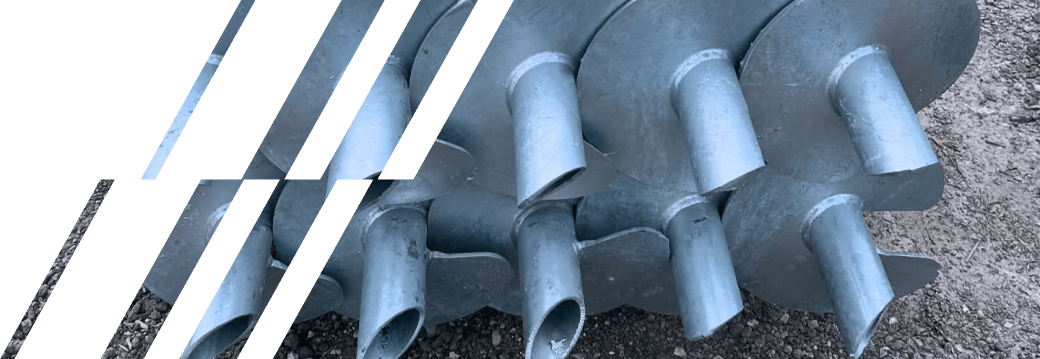
A helical pile is a steel shaft with one or more helix plates welded near the tip. Hydraulic equipment turns it into the ground like a giant screw until it reaches soil dense enough to carry the design load, below the frost line. The pile holds weight the moment it is in, so there is no excavation, no spoil pile and no concrete cure time. Helical piles are also called screw piles, helical piers or screw pile footings.
The install looks simple from the driveway. A machine with a hydraulic drive head grabs the pile, lines it up on the mark, and turns. The helix plates pull the shaft down the way a wood screw pulls into a stud. Extensions get bolted on as the pile goes deeper.
What matters is what the machine reports back. The drive head measures how hard it has to work to keep turning, and that installation torque tracks the strength of the soil the helix is cutting through. When the torque climbs to the number the project engineer specified, the pile is in competent ground and the crew stops. Depth is an outcome, not a target. Two piles ten feet apart on the same lot can finish at different depths and both be right.
Once the pile is at capacity, a bracket or cap goes on top and the structure bolts to it. A framing crew can start the same day.
| Part | What it does |
|---|---|
| Shaft | The central steel tube or square bar that carries load down to the helix. Round shafts handle lateral load and bending better; square shafts drive well through hard ground. |
| Helix plate | The steel disc welded near the tip. It cuts into the soil, pulls the pile down and does the actual bearing. More plates or bigger plates mean more capacity. |
| Extensions | Bolted sections added as the pile goes deeper, so the pile can reach whatever depth the soil demands. |
| Cap or bracket | The connection at the top. A new-build cap takes a beam or post; an underpinning bracket clamps to an existing footing. |
| Coating | Hot-dip galvanizing, which is what keeps a steel foundation from rusting in wet Ontario ground. |
There is no single answer, and anyone who gives you one without seeing the site is guessing. Capacity comes from three things: the size of the shaft, the size and number of helix plates, and the soil the plates end up in. A small deck pile and a pile under a commercial column are the same idea at very different scales.
The useful part is that capacity gets confirmed on every single pile. Installation torque is correlated to capacity using the method set out in ICC-ES AC358, the acceptance criteria for helical pile systems, and the readings get recorded. Your engineer sets the required number before the crew arrives, and the field report shows whether each pile hit it. Compare that with a poured footing, where nobody measures anything after the truck leaves.
Full material and installation specs are on our helical piles page.
We install four shaft sizes: 2 3/8 inch, 3 inch and 3 1/2 inch round shaft for residential and light commercial work, and a 6 5/8 inch large-diameter shaft for heavy commercial loads. Helix plates come in 8, 10 and 12 inch diameters, and a pile can carry more than one plate when the soil or the load calls for it.
Capacity is not printed on the shaft. It comes from the shaft, the helix configuration and the soil the plates finish in, and it is proven on site by the installation torque (more on that below). The figures below are the configurations on our helical piles specification page; the rated capacities for a specific configuration are in the product evaluation report, which we supply with the engineering package on request.
| Shaft | Helix | Where it is used | Typical structures |
|---|---|---|---|
| 2 3/8″ round (M1) | 8″ | Light residential loads in ordinary soil | Decks, gazebos, sheds, pergolas, fences and small porches |
| 3″ round (M2) | 10″ | Heavier residential and light commercial loads, or softer soil that needs a larger plate | Additions, garages, cottages, sunrooms, docks and boathouses, signage |
| 3 1/2″ round (M3) | 12″ | House and cottage foundations, underpinning, commercial pads | New home foundations, foundation repair brackets, modular buildings, equipment pads |
| 6 5/8″ large diameter | Engineered per project | Heavy commercial and industrial loads, high lateral or uplift demand | Commercial structures, solar racking, boardwalks and marine works, industrial equipment |
Three things move a job up the table: heavier loads, weaker soil, and lateral or uplift demand (wind on a sign, ice on a dock, a tall deck). Your engineer picks the configuration; the torque log proves it in the ground.
A helical pile’s capacity is read off the installation torque with one short equation: ultimate capacity = Kt x final installation torque. Torque is how hard the drive head has to work to keep the pile turning, in foot-pounds; Kt is a capacity-to-torque factor that belongs to the specific pile product, established by load testing and published in its evaluation report.
The reason this works is that both numbers come from the same thing: the strength of the soil gripping the helix plates. Firmer ground means more bearing resistance, so the drive head pushes harder and the torque climbs. That same bearing resistance is what carries the structure once the pile is in. Torque is a live measurement of the soil at bearing depth, which is exactly what an engineer needs and exactly what a poured footing never gives you.
Kt is a property of the pile, not the soil. Slim round shafts around 2 7/8 inches commonly run near a Kt of 9 per foot; larger pipe shafts of 3 1/2 inches and up drop to around 6 or 7 because more of the torque is shaft friction; square bar shafts often sit near 10. A worked example: a gauge that stops climbing at 8,000 foot-pounds on a pile with a Kt of 9 gives an ultimate capacity of roughly 72,000 pounds. Engineers then apply a factor of safety, commonly 2 for helical piles under ICC-ES AC358, so that pile is carrying an allowable load in the range of 36,000 pounds. The only Kt that is valid for your job is the one in that pile’s evaluation report, applied by your engineer.
The install log is the proof. Every pile gets its final torque and depth recorded, and the field report goes to the project engineer or the building inspector. That is why a helical pile is the only common foundation where capacity is confirmed on every single element. The full walkthrough, with a sample torque chart, is in understanding helical pile torque to capacity ratios.
They are not the answer to everything, but in Ontario they solve a lot of expensive problems:
A full concrete basement still makes sense on plenty of builds. If you want the side-by-side, read helical piles vs concrete footings.
Soil decides depth and helix choice more than anything else. The pile keeps turning until the torque says the plates have found competent ground, so the same structure can need a 10-foot pile on one lot and a 30-foot pile on the next.
Water changes all of it. A high water table or a wet season lowers soil strength, so the same lot can produce a deeper pile in April than in August. That is one more reason capacity is measured on the day rather than assumed from a drawing.
We quote per project rather than per pile, because the pile count is only part of it. The same deck can cost noticeably different amounts on two lots a street apart, and the reasons are almost always in this list.
We do not publish price ranges on this page because the honest range for a deck and the range for an underpinning job do not overlap, and a number without the loads behind it misleads more than it helps. Send us the loads, the address and a site photo and we can usually tell you the same day where a project lands. Ask for a quote.
A residential helical pile job is usually one site visit for the install itself, with the engineering and layout done beforehand. Here is the order it happens in and roughly how long each step takes.
The foundation follows the structure. If the deck, addition, garage or building needs a building permit under the Ontario Building Code, the pile foundation is part of that permit, and the municipality will normally want stamped drawings for the pile layout and the installation torque records at inspection. Small, low structures that do not need a permit do not need engineered piles either, although the piles still get installed to torque.
What the engineer needs from you is short: the drawings or a sketch of the structure with its dimensions; the loads, or enough about the structure for the engineer to work them out (a hot tub or a second storey changes everything); a site plan or survey showing where it sits; any soil report or nearby borehole data; and a note on access, since a lot that only fits a compact rig limits the shaft size. Our in-house engineering handles the layout and the stamped drawing on most projects, and we supply the mill certificate and product evaluation report when a reviewer asks for them.
Helical piles are not the answer to everything, and it is worth knowing when the other option is the better one. The short version: piles win on frost, soft ground, access, speed and winter; concrete wins when the design wants a full basement or a continuous slab.
| Option | Where it is strong | When the other option is better |
|---|---|---|
| Poured concrete footings | Full basements, continuous strip footings and slabs. Familiar to every inspector and framer. | Piles are better on frost-prone, wet or filled ground, tight-access lots, winter builds, and anywhere excavation and disposal are the expensive part. |
| Sonotubes (cardboard-form concrete piers) | Cheap materials for a small deck on firm, well-drained ground when you can wait for concrete to cure and dig to frost depth. | Piles are better when the hole would fill with water, when the soil is clay or fill, when you cannot get an auger in, or when the deck has to be built this week. A sonotube also has no capacity check; a pile has a torque reading. |
| Diamond Pier and similar pin foundations | Fast, no-dig footings for light decks and small structures on decent soil, with published capacities for the pin sets. | Piles are better once loads climb (roofs, hot tubs, additions), on soft clay or organics where the pins cannot develop bearing, and wherever an engineer wants a per-element capacity record. |
| Driven piles (steel or timber) | Very high capacities and long lengths for bridges, large marine works and heavy industrial foundations, where a pile-driving rig can be mobilised. | Helical piles are better on residential and light commercial jobs because they need a fraction of the equipment, make almost no noise or vibration, can be installed beside an existing building, and can be unscrewed and reused. |
The full cost, time and frost comparison with concrete is on helical piles vs concrete footings.
Search for this product and you will find five or six names for it. They all describe a steel shaft with helix plates that is turned into the ground; the differences are mostly who is talking.
Yes. Helical pile, screw pile, helical pier and screw pile footing all describe the same product: a steel shaft with helix plates that gets turned into the ground. Engineers and code documents tend to say helical pile. Builders and homeowners usually say screw pile.
Deep enough to pass the frost line and reach soil that carries the design load. Across much of Ontario that lands somewhere between about 10 feet and more than 30 feet. The installation torque decides the final depth on the day, not a number on a drawing.
Most residential jobs are done in a day. A deck or shed can be a few hours. The pile carries load immediately, so framing can start as soon as the crew packs up.
The foundation follows the structure. If the deck, addition or building needs a permit, the pile foundation is part of that permit, and the municipality will usually want engineered drawings and the installation torque records. We can supply the field report.
Yes. They unscrew. That is why they get used for temporary structures, site trailers and staging, and it is one of the reasons they are considered a low-impact foundation.
The steel is hot-dip galvanized, which is the standard corrosion protection for buried steel. Coating thickness and soil chemistry decide service life, so aggressive soils get looked at case by case.