Residential Foundations
Commercial & Industrial
Nautical & Marine
Underpinning & Repairs

Foundation Comparison
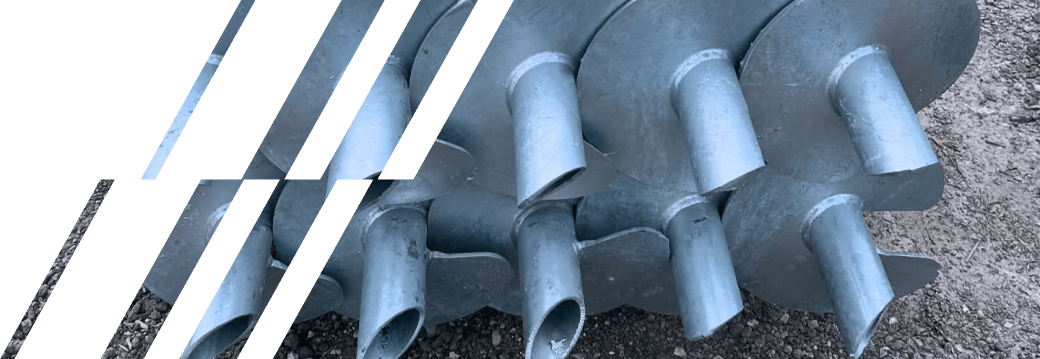
Helical piles are steel shafts screwed below the frost line that carry load immediately, with no digging and no cure time. Concrete footings are poured into an excavated hole and need days to reach strength. In Ontario, piles usually win on speed, winter work, soft or wet soil and tight access. Poured concrete still wins where you want a full basement or a continuous slab-on-grade.
| Helical piles | Poured concrete footings | |
|---|---|---|
| Install time | Hours to a day for most residential jobs | Several days, plus inspection and cure |
| Load ready | Immediately after installation | After the concrete gains strength |
| Excavation | None. No spoil to haul away | Digging, spoil bins and disposal |
| Frost heave | Pile bears below the frost line and resists uplift | Works if the footing is deep enough and stays dry; shallow or bell piers are the usual failure point |
| Capacity check | Installation torque recorded per pile and correlated to capacity | Inferred from mix design and inspection, not measured per footing |
| Soft or wet soil | Pile keeps going until it finds competent ground | Footing sits at design depth whether the soil is good or not |
| Winter work | Yes. Nothing has to cure | Possible, but needs heat, blankets and added cost |
| Site impact | Compact machines, minimal damage to lawns and driveways | Heavy equipment, ruts, spoil piles |
| Removable | Yes. Piles unscrew and can be reused | No. Demolition and disposal |
| Best for | Decks, additions, cottages, docks, modular and commercial builds, underpinning | Full basements, continuous slabs, large monolithic pours |
Pile for footing, steel usually looks more expensive on the line item. Then you add up what concrete actually costs on a real site: excavation, a bin for the spoil, disposal fees, forms, the pour, the wait, the second mobilization for the framer, and the landscaping repair afterwards. That is where the gap closes, and on tight or wet lots it flips.
The honest version is that it depends on your site. Pile count comes from the loads. Depth comes from the soil. Access decides what machine we can use. We would rather look at your drawings than quote a number that turns out to be wrong. Send us the details and we will price it properly.
We install piles for a living and we will still tell you when to pour. Concrete makes more sense when the design needs a full basement or crawl space, when you want a continuous slab tied into the foundation, or when the structure needs a large monolithic mass rather than point loads. Some retaining and below-grade work is the same story.
The two also work together. Plenty of Ontario builds sit on a poured foundation for the main house and helical piles for the addition, the deck or the porch, because that is the cheapest way to stop the two from moving apart.
Most of the deck and addition failures we get called out to are frost problems. Water in the soil freezes, expands, and lifts anything bearing above the frost depth. A concrete pier can do this too if it was placed too shallow or if the sides of the hole grip it.
A helical pile passes that zone entirely and anchors in soil that does not freeze, and the helix plate resists uplift as well as bearing. That is the whole reason screw piles took over deck footings in Ontario. There is more detail in our guide on how frost heave destroys decks, and in the basics guide, what are helical piles.
For point loads, yes, and the capacity is verified pile by pile from the installation torque instead of assumed. What concrete does that piles do not is spread load over a continuous strip or slab, which is why basements and slab-on-grade still get poured.
Yes, when the foundation is designed for the loads and the installation records back it up. Municipalities generally want engineered drawings and the torque log for the piles. We provide the field report.
That is the most common swap we do. Sonotubes rely on being placed deep enough and staying that way. Piles are screwed to a measured capacity below frost, and the deck can be framed the same day.
Buried steel is protected by hot-dip galvanizing, and coating thickness plus soil chemistry drive service life. Aggressive soils get reviewed case by case rather than assumed.
Yes. Piles are installed beside the existing footing and brackets transfer the load onto them, which stops the movement. That is helical pile underpinning.